Proudly Singaporean
Whitening Cream and Anti Ageing Cream Scams: What to look out for?
Recently, the Health and Science Authority of Singapore posted an article about “Stay cautious, stay safe – ‘whitening’ and ‘anti-ageing’ products found to contain mercury and prohibited ingredients”.
In a nutshell, it warns consumers about purchasing whitening and anti-ageing products online, especially from unfamiliar or unverified sellers.
Some products that promise fast or dramatic results have been found to contain dangerously high levels of mercury, potent steroids and other prohibited ingredients.
Yet, we know that the marketing can sometimes be very convincing. A product may look professionally packaged, have thousands of positive reviews and be accompanied by impressive before-and-after photographs.
The danger is that unsafe products do not always look suspicious. Here are some warning signs to look out for.
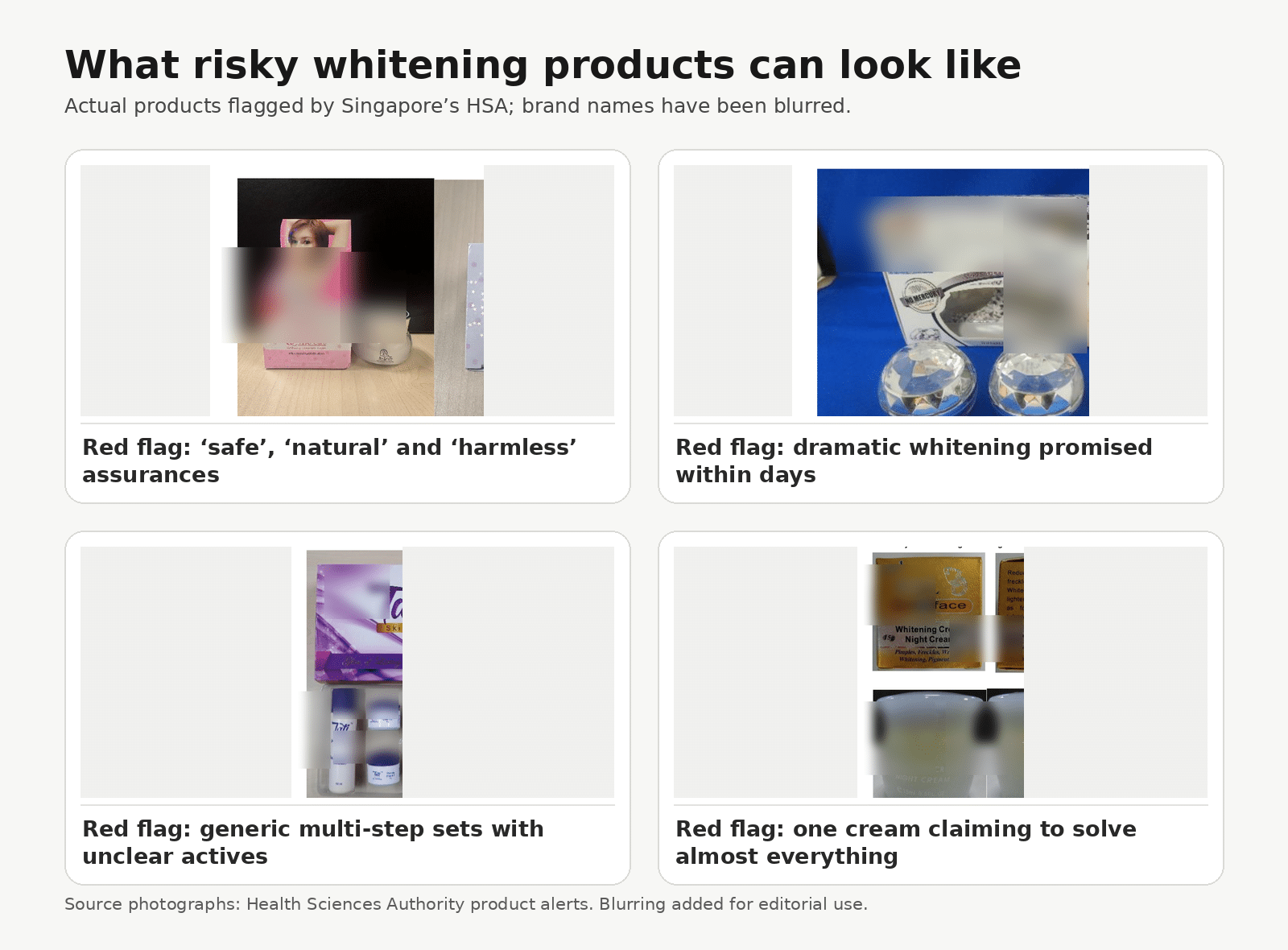
The examples above are actual products featured in HSA alerts. Their brand names have been blurred to avoid promoting or directing readers towards them.
1. It promises visible results within days
Be cautious of claims such as:
- “Whiter skin after one application”
- “Brighter skin in three days”
- “Visible results within five days”
- “Immediate whitening effect”
In previous cases, HSA found products marketed with precisely these types of promises. One claimed to brighten the skin in as little as three days but was later found to contain mercury at around 7,000 times the permissible limit.
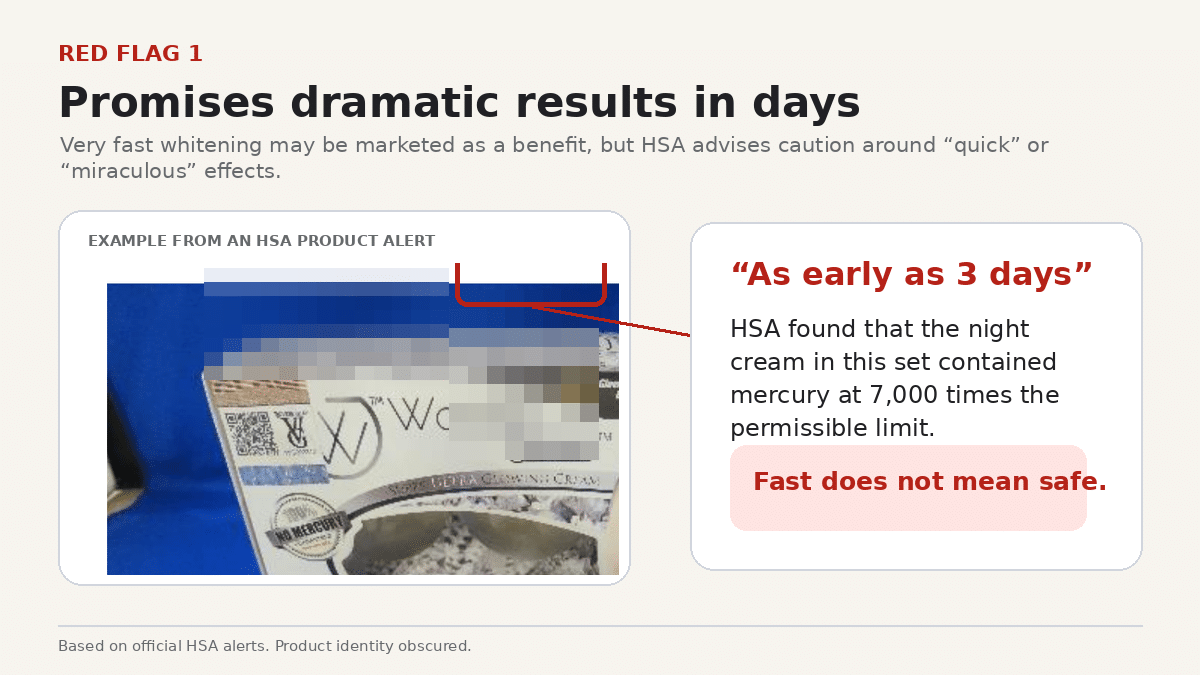
Another product claiming results within five days contained undeclared mercury, with one cream exceeding the limit by more than 40,000 times.
Skincare generally takes time. An unusually rapid or dramatic change does not necessarily mean the product is effective—it may indicate that potent or prohibited ingredients have been added.
2. It makes absolute safety claims
Words such as “100% safe,” “harmless,” “non-toxic,” “no side effects” and “mercury-free” may sound reassuring, but they are not proof that a product has been independently tested.
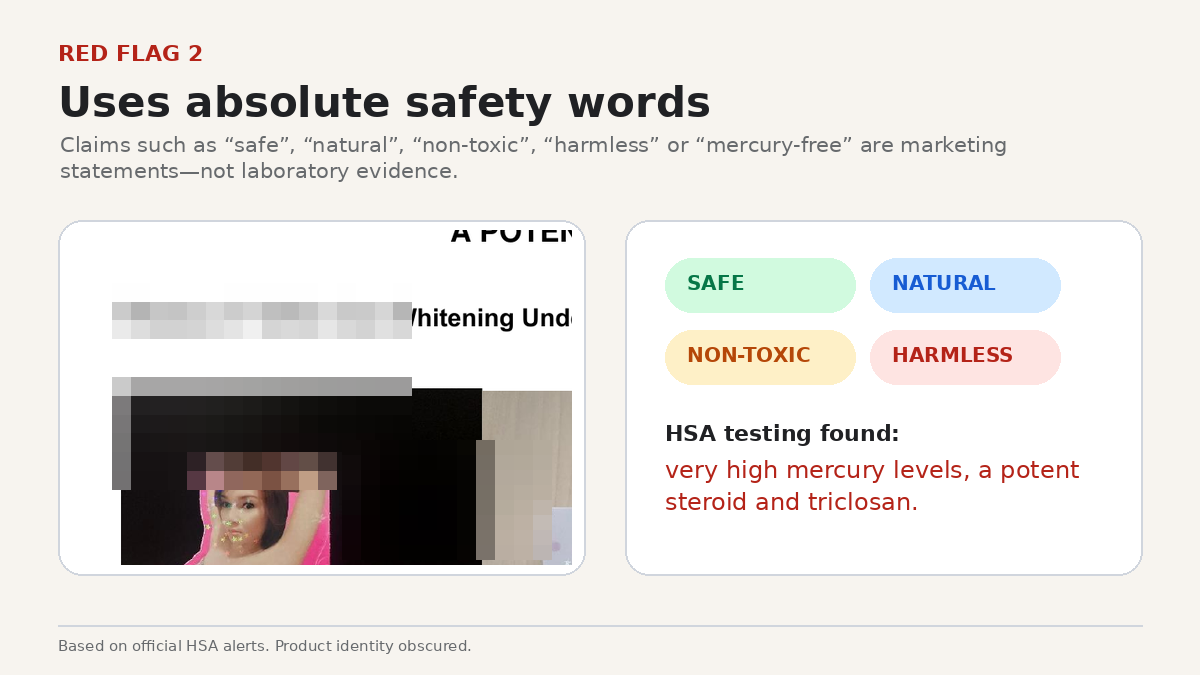
One cosmetic set was labelled “100% No Mercury Guaranteed”, yet its night cream contained mercury at approximately 7,000 times the permissible limit. Another product advertised itself as safe, natural, non-toxic and harmless, but HSA detected very high mercury levels, a potent steroid and an unsuitable preservative in it.
In other words, safety language printed on the packaging is still only a marketing claim.
3. One product claims to solve almost every skin problem
Another warning sign is an excessively long list of supposed benefits.
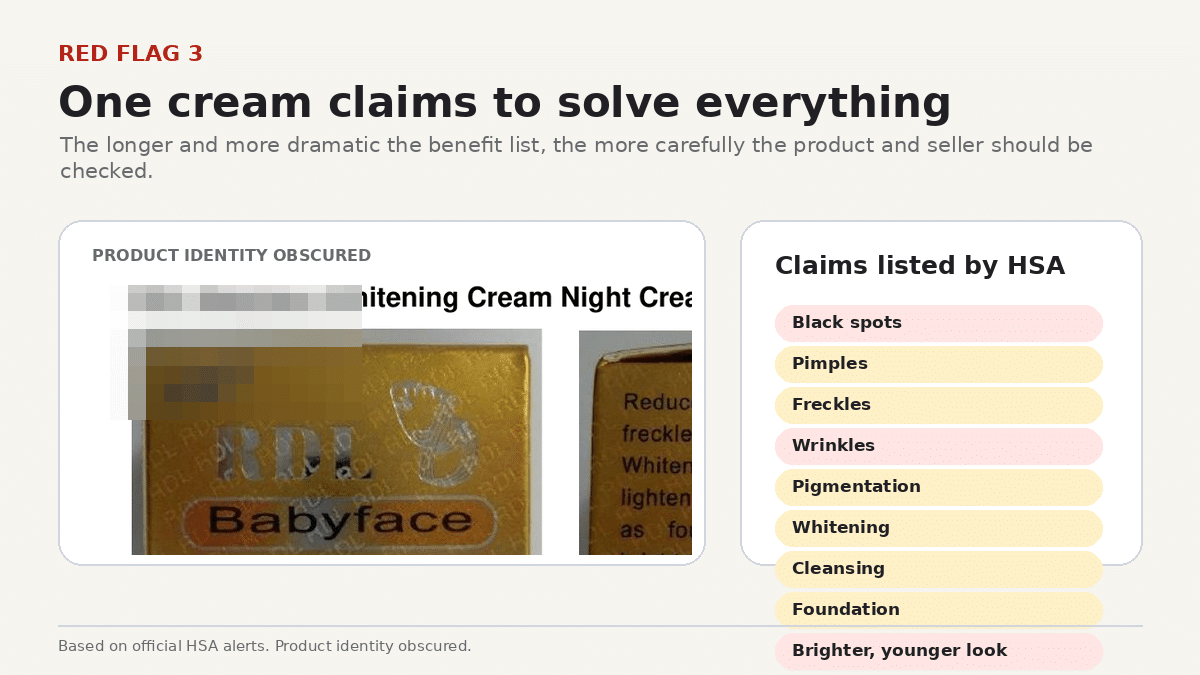
Some products flagged by HSA claimed to address whitening, wrinkles, pimples, freckles, pigmentation, oily skin, dullness, scars and uneven skin tone—all with the same cream. One underarm cream even claimed to reduce odour while whitening and smoothing the skin.
A product is not automatically unsafe because it offers more than one benefit. However, the more exaggerated and wide-ranging its promises are, the more carefully the claims and ingredients should be examined.
4. The packaging does not provide proper information
Under Singapore’s cosmetic labelling requirements, packaging should generally contain information in English, including:
- A full ingredient list
- The product’s name, function and instructions
- The country of manufacture
- The name and address of the local company responsible for the product
- The product quantity and manufacturer’s batch number
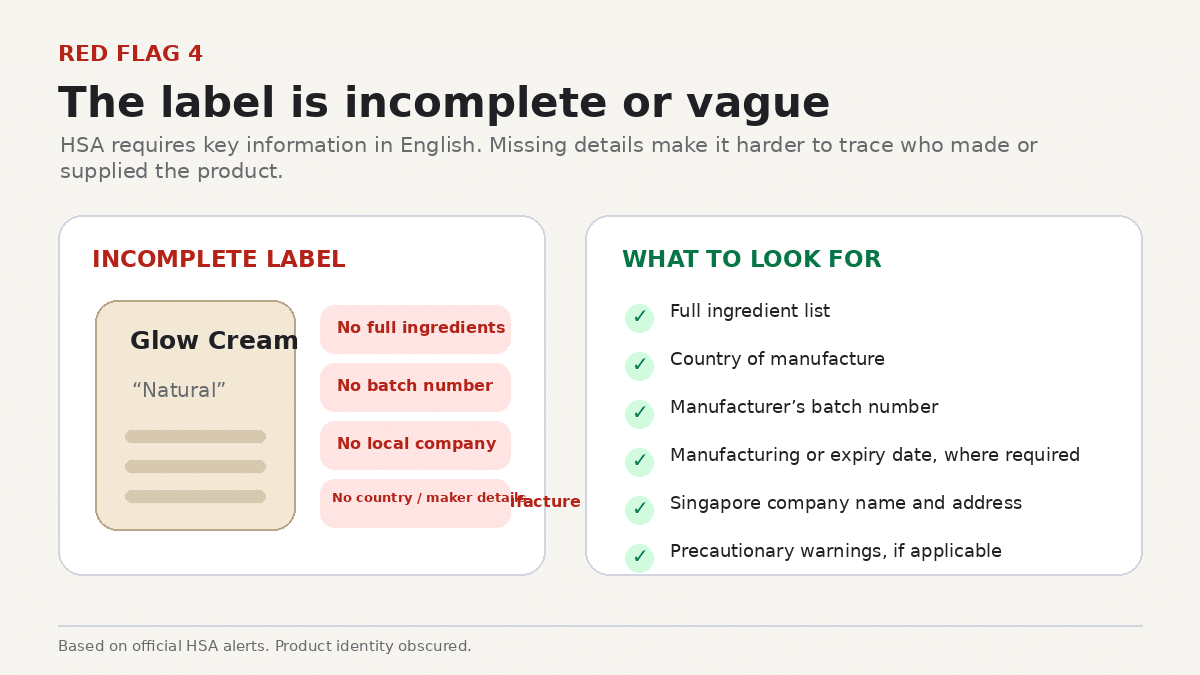
Missing, vague or inconsistent information should therefore be treated as a red flag. HSA previously found two whitening products that did not list their ingredients on either the packaging or accompanying leaflet.
Be especially cautious when a seller refuses to show photographs of the complete packaging, including the back and sides.
5. Reviews are being used as the main proof of safety
A high rating can tell us that buyers liked the product or seller. It cannot tell us whether the product has been laboratory-tested for mercury, steroids or undeclared prescription ingredients.
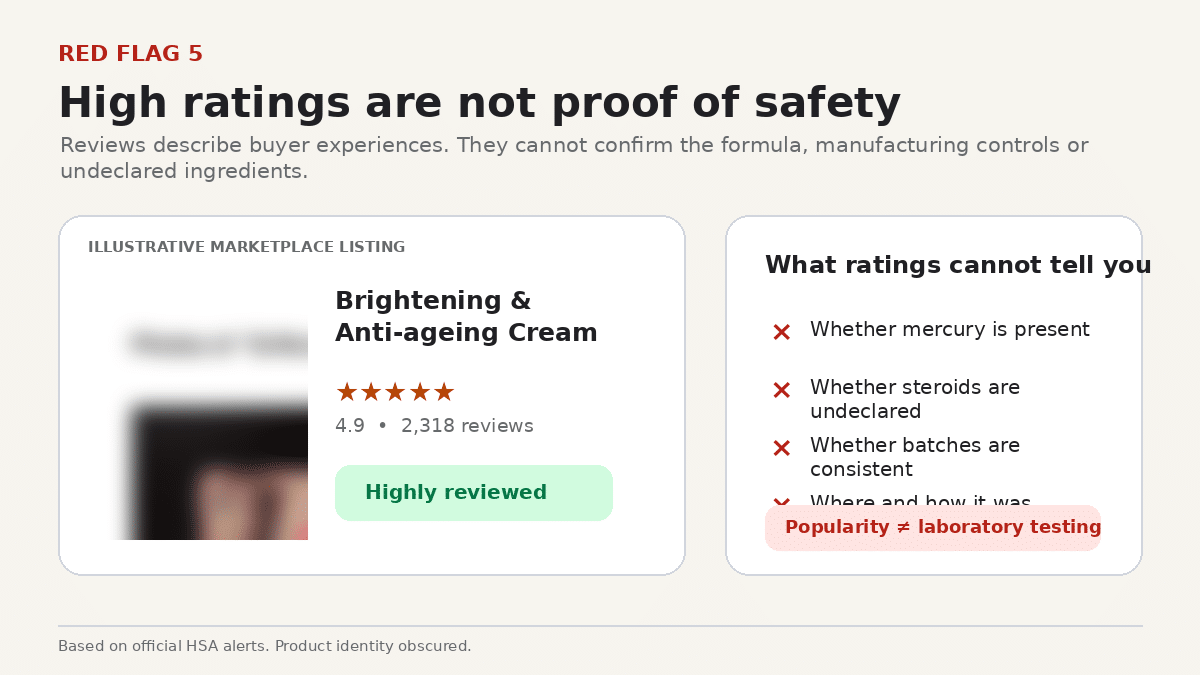
Several products investigated by HSA were sold on major local marketplaces, including Shopee, Lazada and Carousell. Their presence on a familiar platform did not make them safe, and the affected listings were subsequently removed.
The same applies to recommendations from influencers, relatives or friends. They may be sharing their genuine experience, but they cannot confirm what is actually inside the product or whether different batches contain the same ingredients. HSA has warned that adulterated products may have poor quality control, with the amount and type of hidden ingredients varying between batches.
6. The seller claims that the cosmetic is “HSA-approved”
This wording should make you pause.
Companies generally need to notify HSA before supplying cosmetic products in Singapore. However, HSA clearly states that an acknowledgement of notification is not an endorsement or approval of the product, as cosmetic products are not individually evaluated and approved before sale in the same way as registered medicines.
Consumers can search HSA’s database of notified cosmetic products as an additional check. However, notification should not be treated as a guarantee that every claim made by a seller is accurate.
What to do before checking out
Before purchasing, take a few minutes to examine the listing beyond its star rating. Look for a complete ingredient list, batch number, country of manufacture and an identifiable local company responsible for the product. Search the product name together with terms such as “HSA warning” or “mercury”, and purchase from reputable pharmacies or established retailers with a genuine presence in Singapore.
Most importantly, do not mistake faster results for better results. In several HSA cases, the speed and effectiveness of the product were precisely what caused consumers to suspect that something was wrong.
Anyone using a product that has been named in an HSA alert should stop using it and seek medical advice if they experience adverse effects. Where prolonged use of a steroid-containing cream is suspected, consult a doctor promptly, as suddenly stopping it can sometimes produce withdrawal symptoms or worsen the underlying skin condition.



news via inbox
See our latest reviews of goods, conducted right here in Singapore.